God’s Kingdom Designed Before Creation
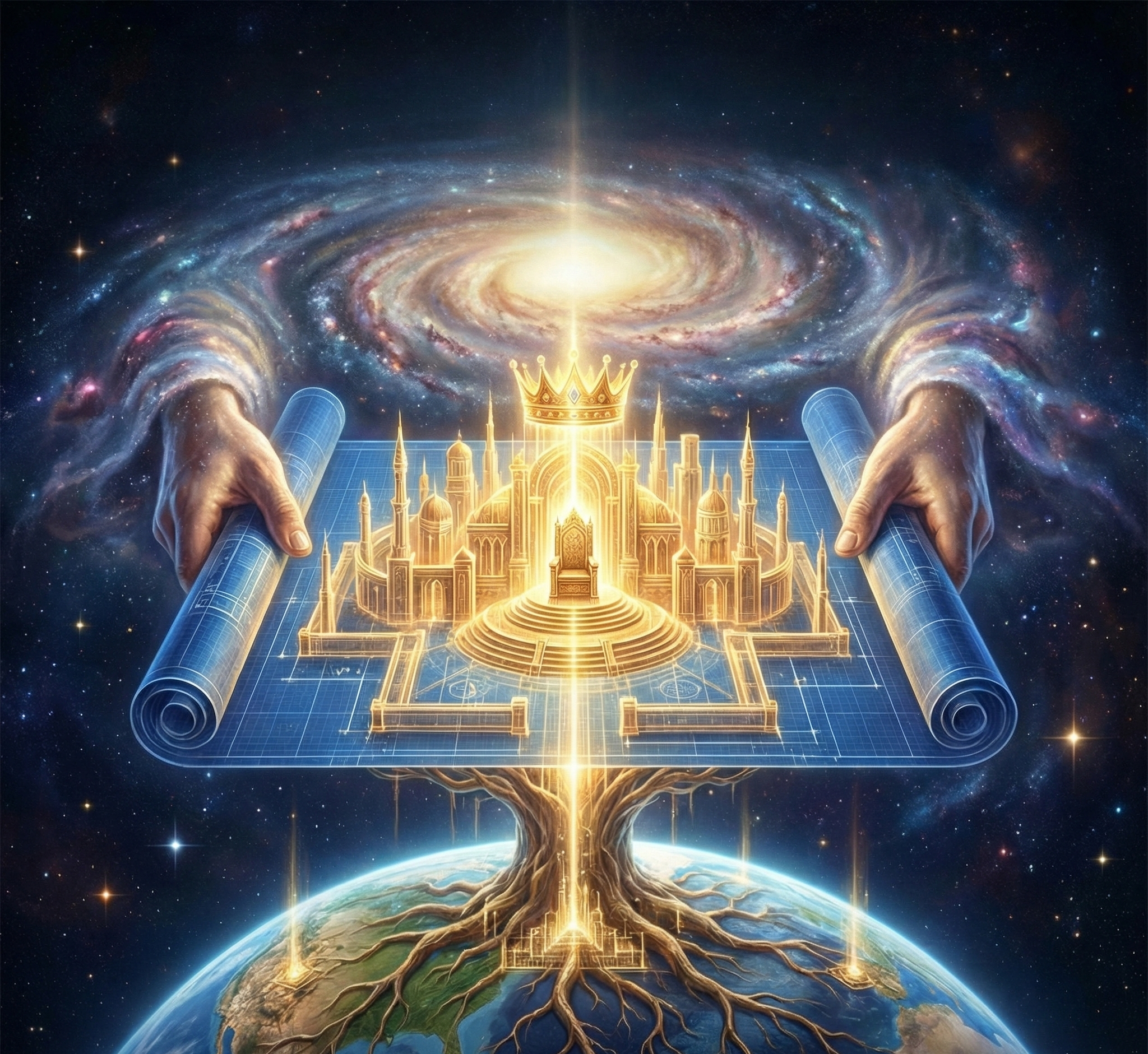
In the study of eschatology and the Divine Plan, few concepts are as stabilizing and awe-inspiring as the realization that God’s Kingdom is not a reaction to history, but the very reason for history. In The Theocratic Kingdom, G.N.H. Peters lays out a proposition that shifts our eyes from the chaos of the present to the immutable purpose of the past.
This truth anchors the believer in the reality that the Kingdom was the original blueprint in the mind of the Creator. As Peters notes, the Scriptures reveal that “the Divine purpose relating to the kingdom existed in the mind of the Eternal before the creation of the world” (Matthew 25:34, John 17:24, Ephesians 1:4, Hebrews 4:3, 1 Peter 1:20, Revelation 13:8).
Here are key insights regarding this eternal design, drawn directly from Peters’ work.
Creation Was Preparatory for the Kingdom
We often view creation as a separate event from the Kingdom, but Peters argues they are inextricably linked. The physical world was not an accident; it was the intended stage for God’s glory.
“In the mind of the Divine Architect and Purposer, the contemplated final use of this world was allied with its origin”
—Prop. 2, Obs. 1
Critics may mock the biblical language of the “foundations of the earth,” but Peters reminds us that “the general analogy of the Scriptures teach that these are in the creative power, wisdom, love—the attributes—of the Creator” (Job 26:7).
We can properly infer the dignity of this subject, for it is “comprehended in the eternal counsels and evolved from the ever-existing ‘purpose of Him, which worketh all things after the counsel of His own will.’”
The Kingdom Belongs to the Earth
One of the most vital distinctions in The Theocratic Kingdom is the location of this Kingdom. It is not merely a spiritual abstraction, but a physical reality tied to this planet. Indeed, “The exercise of creative power, and its continued exhibition in behalf of man and the world, clearly shows the Divine determination to establish this kingdom.”
This is not a distant reality; rather:
“This kingdom is one pertaining to the earth… ‘From the foundation of the world’ is indicative that God purposed this very earth, when founded, for this kingdom.”
—Prop. 2, Obs. 2
While the Fall introduced sin, the original purpose remains. Peters argues that while unbelief views nature as an end in itself, the doctrine of the Kingdom proposes “a renewal, a deliverance, a restitution, which shall free nature, exalt man, and glorify the Maker” (Ephesians 1:4, 1 Peter 1:20).
A Restitution of What Was Marred
Because the Kingdom was designed before the Fall, the current state of the world is not final. The curse must be reversed to match the original blueprint.
“Such phraseology involves, of necessity, owing to the fall and entailed curse, a glorious restitution for which provision is to be made… it is requisite, before God’s purpose is fully carried out, to restore that forfeited perfection.”
—Prop. 2, Obs. 3
The King and His Rulers Were Preordained
The Kingdom implies a King and a government. This was not an afterthought.
“This phraseology respecting the kingdom includes, in view of expressed predetermination, the appointment or preordination of the king”
—Prop. 2, Obs. 4
Furthermore, it includes the rulers:
“It also comprehends the number of the rulers, elect, heirs or inheritors of the kingdom… as well as every particular, provisionary and realized, pertaining to it”
—Prop. 2, Obs. 5
History and Time Are Ordered for the Kingdom
Why has history unfolded in this specific way? Peters suggests that the very ages are structured to lead us to this Kingdom. The Kingdom is the beginning and ending of the ages.
“In the ‘eternal purpose,’ or ‘the purpose of the ages,’ etc., is included the notion that time itself is embraced in God’s plan with special reference to Jesus Christ as the King of the kingdom.”
—Prop. 2, Obs. 6
Whether we look at the Adamic, Abrahamic, or Church ages, they are not random dispensations but are, as Paul describes, moving toward a divinely appointed final age in which all things are summed up under Christ (Eph. 1:10 KJV). The ages, then, are not merely periods of time but stages in a unified plan, progressing toward the visible reign of the King. This is why, in Matthew 24:3, the disciples ask about “the end of the age”: they understood that the close of an age signals not chaos, but the next decisive step in the Kingdom’s fulfillment.
The Unchanging Nature of the Plan
Because this plan is rooted in God’s attributes, it cannot be easily cast aside or spiritualized into nothingness.
“We also justly infer, that God’s will thus expressed respecting the kingdom indicates a Divine plan, which, in view of His attributes, necessarily embraces unity of design. Therefore, when the kingdom is once defined by the Spirit, no change or modification can possibly be allowed without the most express declarations from God announcing it.”
—Prop. 2, Obs. 7
Furthermore:
“The idea of the kingdom being thus identified in its connection with eternal purpose and with
creation, God will undoubtedly accomplish His revealed will concerning it, confirmed as it is even by
oath. God Himself stands pledged to the ultimate realization of this idea.”
—Prop. 2, Obs. 3
Wisdom Rejoices in the Earth
Finally, this doctrine vindicates the wisdom of God. It shows a cohesive narrative from Genesis to Revelation. In “Proverbs 8:31, wisdom is represented as rejoicing in the habitable part of his earth, and as delighting in or presenting my delights to the sons of men.”
Ultimately, this grand design proves the existence of a guiding Mind:
“The greater the work contemplated—and there is none greater than this kingdom—the more clearly ought we to see the intelligence of the Mind that originates it, and the power of the Will that performs it.”
—Prop. 2, Obs. 9
As we study, we find that known unto God are all His works from the beginning of the world (Acts 15:18), and we can rest in the certainty that He who designed the foundation will also bring about the glorious capstone.