The Kingdom They Expected: How Jews, Disciples, and Early Christians Defined “Kingdom”
The Kingdom Framework
- Part 1: A Familiar Announcement: Hearing the Kingdom Through First-Century Ears
- Part 2: The Critics, the Church, and the Collision: How Modern Theories Opened the Door to Rationalism
- Part 3: The Kingdom They Expected: How Jews, Disciples, and Early Christians Defined “Kingdom” (You are here)
If the first post entered the world of the first-century Jew to hear the announcement, and the second examined the controversy created by later reinterpretations, this third post turns to the positive theological reality: what the kingdom meant to the people who heard it first. As in the previous two posts, we will branch out into future propositions to continue providing a high-level, concise backdrop before diving into the propositions one-by-one.
John’s audience understood the kingdom because they understood the Old Testament. Jesus’ disciples understood the kingdom because He preached it in the same terms. Mary, Zechariah, the prophets, the apostles, and the earliest church all shared a unified expectation—one rooted in covenant, prophecy, and the literal promises of God.
And this expectation appears with startling clarity in the phraseology itself.
The Phraseology
When the Jews heard John use the word kingdom, they would have done what Dr. Andrew Woods insists all interpreters must do:
“…not define it by their favorite theological system, but rather… define it by the Old Testament.”1
This is the unavoidable starting point.
George Peters explains in Proposition 22 that the language Jesus and John employed was not new, not reinterpreted, and not adjusted. It was the full, inherited vocabulary of Old Testament expectation:
“First is to be found the well-known expectations of the Jews based on a literal interpretation of the prophecies; next, these are summed up in the expressive phrases ‘Kingdom of heaven,’ etc., taken, as numerous writers inform us, from Daniel 7:13-14; finally, John, Jesus, and others take the very phraseology adopted by the Jews to designate a certain definite Kingdom, and use it without the slightest intimation or explanation of a change in its meaning; and this employment of the phrases, with a correspondent Jewish meaning attached, continued… at least down (Acts 1:6) to the ascension of Christ.”
—Prop. 22, Obs. 1
Peters then cites even those who reject literal interpretation but still admit the force of the language:
“There is reason to believe not only that the expression ‘Kingdom of heaven,’ as used in the N. T., was employed as synonymous with ‘Kingdom of God,’ as referred to in the Old Testament, but that the former expression had become common among the Jews of our Lord’s time for denoting the state of things expected to be brought in by the Messiah. The mere use of the expression as it first occurs in Matthew, uttered apparently by John the Baptist and our Lord Himself, without a note of explanation as if all perfectly understood what was meant by it, seems alone conclusive evidence of this.”
—Prop. 22, Intro
The conclusion is plain enough: the kingdom Jesus announced was the same kingdom the prophets described and the same kingdom the Jews awaited.
Defining the Kingdom by the Old Testament
Dr. Andrew Woods presses a simple but decisive point:
“So what do you have in Matthew 3:2? You just have the word ‘Kingdom’ and it’s not defined. So I’m not free to pour into that word another definition. What I am obligated under God to do is to search the Old Testament and figure out how prior revelation defines that term; it is the geo-political and spiritual rule of Christ manifested on planet earth… and you see, the amillennial system… completely pours a bunch of meaning in that word Kingdom that you’re not going to find anywhere in the Old Testament.”2
Woods’ point is hermeneutically airtight: If Jesus does not redefine the term, the Old Testament remains the authoritative dictionary.
A Thought Experiment: Hearing the Announcement as a First-Century Jew
Imagine being transported back into that moment. You possess no New Testament. You have only:
- Daniel’s vision of the Son of Man receiving dominion
- Isaiah’s royal child ruling with justice
- Jeremiah’s Branch restoring David’s line
- Zechariah’s promised King coming and reigning
- The covenant guarantees to Abraham and David
You also know your own history; that even when Israel fell under harsh discipline, exile, or rebuke, God never abandoned His covenant people. Judgment was real, but it was never final. Again and again, Scripture taught that after a period of chastening, God restored His people and turned His face back toward them.
Now here we are, John appears, fulfilling Isaiah 40:3 and Malachi 3:1, announcing:
“Repent, for the kingdom of heaven is at hand.”
How would you define kingdom?
You would define it exactly as your Scriptures had taught you:
- a restored kingdom to Israel
- ruled by the Messiah
- from David’s throne
- on earth
- in fulfillment of covenant promises
This expectation does not arise from naïve optimism or cultural fantasy, rather it is the product of centuries of divine faithfulness in which judgment was followed by restoration.
And this expectation forms the backbone of the entire New Testament narrative.
Implications of the Announcement
Woods simplifies the force of the preaching into plain-language paraphrase:
“…what is being said here by, ‘repent for the Kingdom of heaven is at hand’ is that the unchallenged rulership of God in heaven has the potential of manifesting itself to the earth as Jesus rules this planet of sinners with a rod of iron, where His will will never be second-guessed. And to get it, Israel, all you have to do is fulfill your condition, because, genealogically the guy you’ve been waiting for is here, just enthrone Him on His terms and the Kingdom will come. Because, Israel, once you do that you will not just be the owner but the possessor, the covenant structure will be satisfied, and the Kingdom will come.”
Everything about the announcement is Davidic in orientation.
This is why Matthew begins his Gospel with a genealogy centered on David:
“The record of the genealogy of Jesus the Messiah, the son of David, the son of Abraham…”
Matthew structures the genealogy to highlight that Jesus is:
- the promised Son of David
- heir to the throne
- fulfillment of 2 Samuel 7
- continuation of the Abrahamic line
The structure itself is a theological argument: Jesus is the King of the promised kingdom.
Mary and Zechariah: The First Two Witnesses of the Kingdom
Before John or Jesus ever preach, Mary and Zechariah give Spirit-filled interpretations of the events unfolding around them.
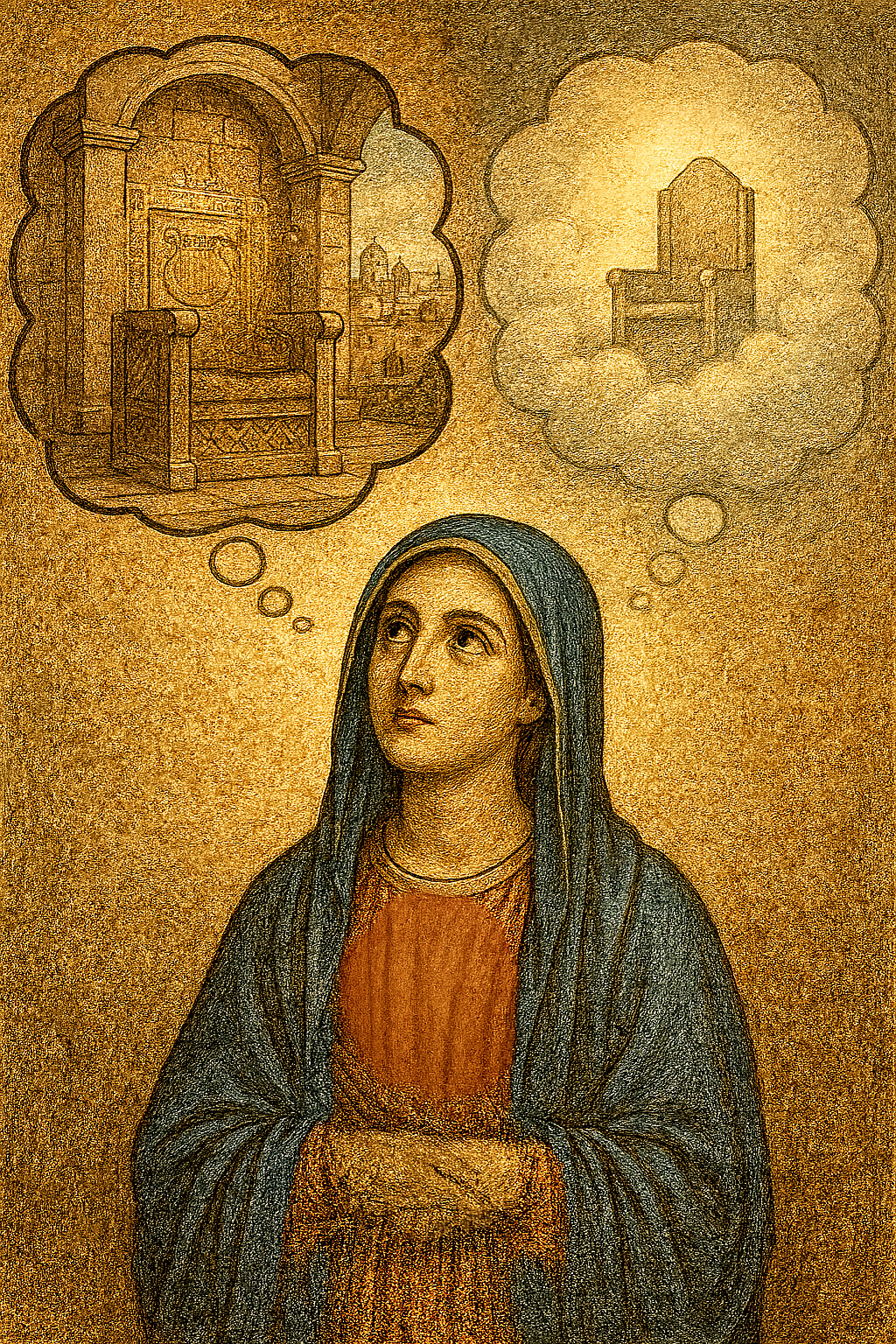
The Angel’s Announcement to Mary
No spiritualizing. No redefinition. No hint that the throne is heavenly or figurative.
The promise is explicit: David’s throne, David’s house, David’s kingdom—as foretold in the covenant (2 Sam. 7; 1 Chron. 17). Mary’s response makes clear that she understood it this way. Her song recalls Israel’s history and God’s faithfulness to His promises, rejoicing that what was sworn to Abraham would now be fulfilled “to Abraham and his descendants forever” (Luke 1:55). Nothing in her praise suggests anticipation of a transformed or symbolic kingdom—only fulfillment.
Zechariah’s Prophetic Prayer
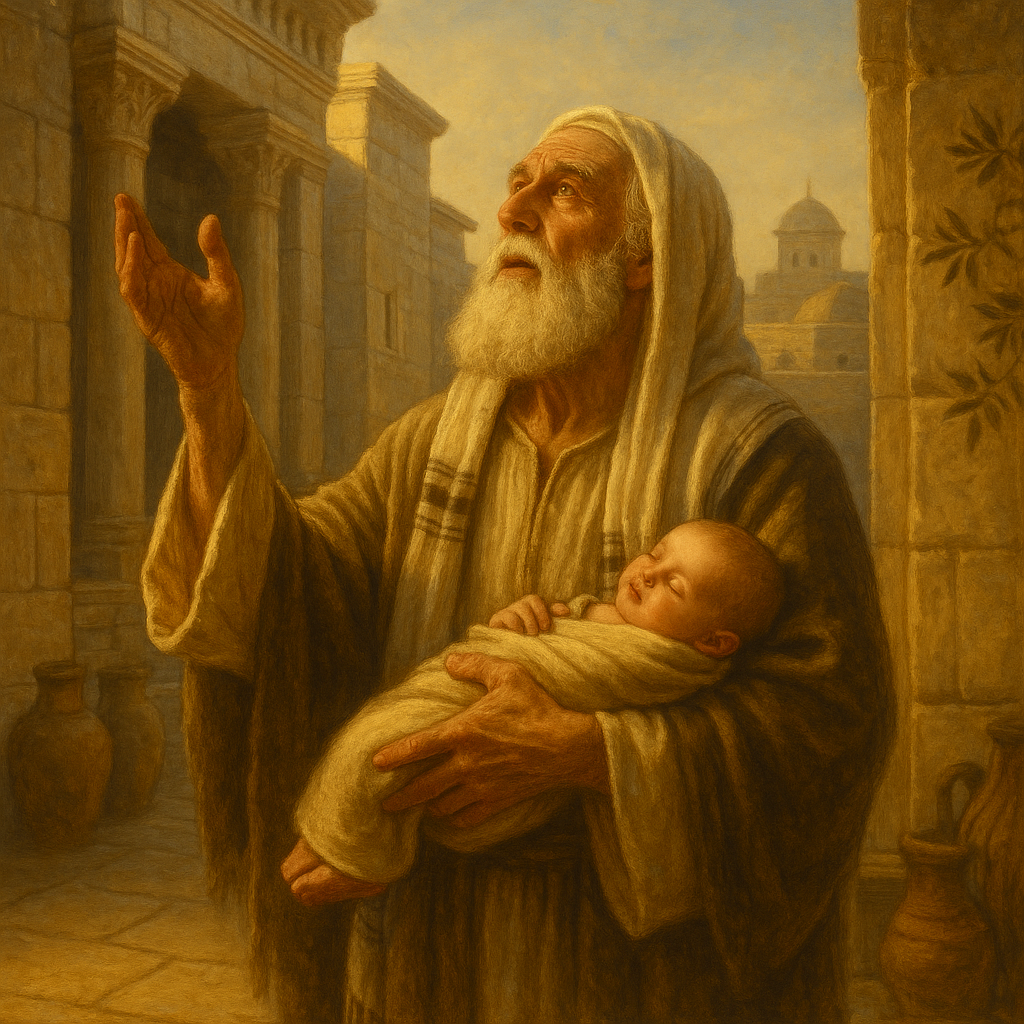
Zechariah’s prayer overflows with covenant language:
- the Davidic covenant (vv. 69–70)
- the Abrahamic oath (vv. 72–73)
- national deliverance (vv. 71, 74)
- restoration and righteousness (v. 75)
By the miraculous birth of his own son and the imminent birth of Christ, Zechariah understands these events as the beginning of fulfillment, not a reinterpretation. He explicitly ties the coming King to the original Abrahamic covenant—sworn by oath—and to the Davidic promise of a ruling Messiah. John’s role is not to redefine the Kingdom, but to prepare the way for the King who will establish it.
This raises an unavoidable question: Would God speak this clearly, fulfill these promises literally in part, awaken such faith and expectation in Mary and Zechariah—and then later transform the meaning of the kingdom into something else entirely?
Scripture gives no such indication. Elizabeth herself affirms that Mary’s faith rests on promises that will be fulfilled (Luke 1:45). The issue is not whether the kingdom will come, but when.
This is not symbolic spirituality. This is covenant expectation—exactly as the prophets promised.
Peters reflects on the impossibility of God “redefining” such promises:
“if David’s throne and kingdom is not David’s throne and kingdom as the words indicate, and as fondly believed in for centuries, but is, as men in their wisdom afterward developed, the Father’s throne in heaven and the Father’s Kingdom on earth and in heaven, how then can we reconcile it with God’s own assurances of veracity, desire to instruct, undeviating truthfulness, etc., that He would clothe His own gracious and merciful words in a dress calculated to deceive, and which did beguile the Jews and Primitive Christians, His children, into a false faith and hope. No! never, never can we receive any theory, however plausibly and learnedly presented, which thus reflects on God’s goodness, makes Him virtually a party to gross deception, and which degrades the intelligence and piety of former saints. Who can censure us for believing in a sense so generally admitted as given by God Himself, placing ourselves where prophets, pious Jews, and the early Christians stood? Having thus in the outset a vantage ground, needing not to prove what multitudes already concede, let us lay aside our “worldly wisdom,” and in a childlike disposition for instruction, follow this grammatical interpretation, carefully gathering up the detached portions, and see where it will lead us. It will reveal a strangeness most surprising, a sublimity most inspiring, and a beauty most delightful, in God’s work.”
—Prop. 21, Obs. 2
This is one of the most forceful arguments in the entire work.
John Walvoord, commenting on the Davidic covenant, confirms the same point:
“In this and other Old Testament references there is no allusion anywhere to the idea that these promises are to be understood in a spiritualized sense as referring to the church or to a reign of God in heaven. Rather, it is linked to the earth and to the seed of Israel, and to the land… Such a situation does not prevail in this present age and is not related here or elsewhere to the reign of Christ from the throne of His Father in heaven rather than the throne of David on earth.”
This expectation is not fringe. It is the unified witness of:
- the prophets
- the covenants
- Mary
- Zechariah
- John
- Jesus
- the apostles
- the early Church
The Framework That Makes Sense of Everything
The only framework that fits every detail of the announcement, every expectation of the Jews, every covenant promise, and every prophetic utterance is:
- The Old Testament defined the kingdom literally.
- The Jews, including Apostles, expected that literal kingdom.
- John and Jesus preached that same kingdom.
- Mary and Zechariah celebrated its literal fulfillment.
- Jesus never redefined the kingdom or corrected the expectation.
- Israel’s rejection postponed—not transformed—the kingdom.
- The future messianic kingdom still awaits literal fulfillment.
This concludes the high-level overview that sets the stage for the rest of what this blog is dedicated to. With this framework established, we are now prepared to continue forward with the careful, sequential study. Continuing with proposition 2 and onward, we will begin walking through George N. H. Peters’ propositions one by one, allowing his arguments to unfold in the order he constructed them, tested against Scripture, history, and reason.
In the next post, we discuss how it was purposed in eternity: God’s Kingdom Designed Before Creation.